
My son's diabetes is making him a better footballer. He just needed to see it.
For the past ten years, me and my wife have been managing Type 1 Diabetes with our son. For those who know what that's like, I salute you. The best description I've heard about managing T1 is that it's like riding a bike on a trapeze, while the bike's on fire and the trapeze is on fire and there are sharks underneath. Yes, they are also on fire.
Good T1 management means constantly balancing insulin against carbs, activity, stress, and a hundred other variables every day, 24/7. Get it wrong in one direction and blood sugar goes dangerously high. Get it wrong in the other and you have an emergency on your hands. We have great technology now — a hybrid closed-loop pump that automates much of the insulin delivery, continuous glucose monitoring, but the understanding and the daily management still sits with the patient and the family. You have to get smart fast on nutrition, on the technology, on your own body, warning signs and how different foods affect your blood sugar levels.
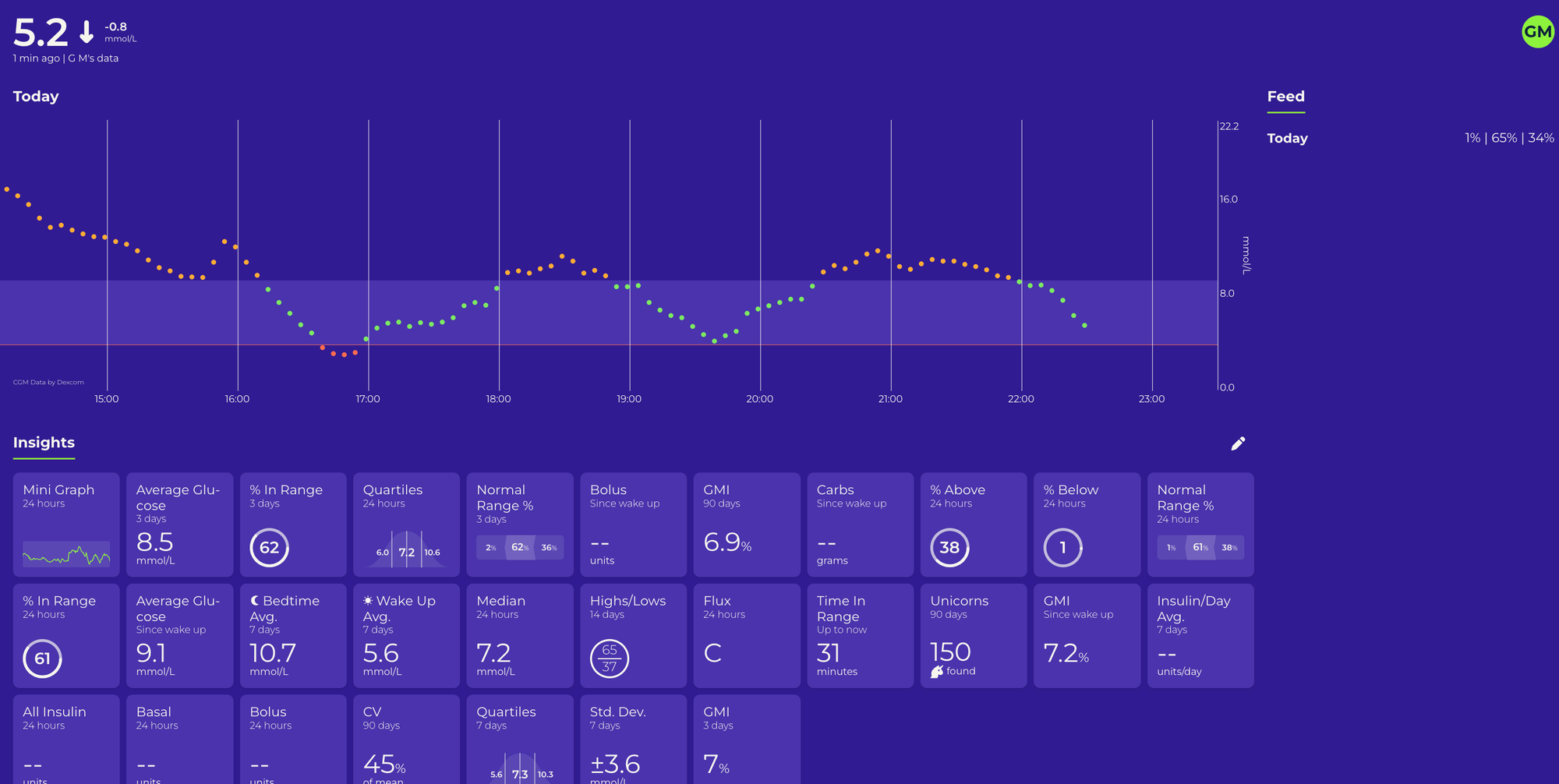
So here's the problem none of that knowledge solved for me. How do you move a 12-year-old from doing the right things to understanding why they matter and being motivated by the outcomes that good diabetes self care also unlock for him instead of self care driven by fear of diabetes.
So I thought about what he actually cares about. Football. Computer games. FIFA. Player ratings, training, upgrading, improving the player, telling his mates. And I thought, what if I connect everything we do to manage his diabetes directly to a set of player ratings. He doesn't need to understand complicated medical data, he just needs nudges and feedback loops that tell him he's making progress on things that matter to him.
Here's the thing that connection is real, not just a reframe to get him to take action. Staying in range overnight means better recovery and sharper concentration the next day. More protein, less sugar means more sustained energy on the pitch and improved blood sugars and less spikes. Good glucose control means less fatigue, better decision-making, faster reactions. The physiological requirements of great diabetes management and peak athletic performance are the same requirements. His goals are aligned and the benefits to him as a diabetic and young athlete are huge. He just couldn't see it yet. There are more athletes managing Type 1 at the top level than most people realise, the evidence is already there.
We have all the data. Continuous glucose monitor, insulin pump logs, meal records — it's all there. What we've never had is a way to present it in language that means something to him specifically. Not a clinician's dashboard built for adults. Not a generic health app. Something built around how he thinks, what motivates him, in his context.
The data isn't unique to my son. Lots of T1D patients have a Continuous Glucose Monitor, an insulin pump, carb logs. The logic is the same for what good management looks like, what patterns matter, what the numbers mean. What's unique is the presentation. How you communicate all of that to this specific person, in their language, using the things that matter to them. That's the layer that's never existed. Not because it was technically impossible, because nobody could justify building it for one person. AI changes that calculation entirely and allows me and others to build for the unique requirements of just one user.
That's what I'm building. An application layer above all that data, reading his numbers, his patterns, his trends, and translating them into a format that makes sense to a 12-year-old who wants to be a better footballer. And I can build it now, with AI tools that genuinely help me build in a way that simply wasn't possible before without significant time and effort in something that may not work how I expect.
The connection between my son's diabetes and his football has always been there, what's never existed is a way to show it to him, in his language, through his lens, using what actually matters to him. That's what I'm building.
It's an experiment. I don't know if it will work. That's the point. I can build, iterate and learn and experiment more until we get the right solution for my son.
AI isn't just making developers faster. It's making builders of people who couldn't build before. It's letting us create personalised solutions for individual people, not products designed to serve the average user, but something that fits one specific person's life, context and language. It might only ever have one user. In this case, that's exactly right. The gap between having an idea and being able to build it has collapsed.
The #WeAreNotWaiting community, parents who have been hacking together DIY diabetes tech for over a decade, proved that technically-minded people could build things the industry hadn't got round to yet. What's different now is that you don't need to be technically-minded to start. You just need a problem worth solving and the drive to try.
I'm building the MVP and testing it on myself first, understanding how it handles different scenarios, checking the logic, stress-testing it before my son sees it. To be clear, the system can never deliver insulin or make clinical decisions. It monitors, it interprets, it communicates. That's it. His safety is managed by his medical team, his pump, and his CGM. This sits on top of all of that.
If you're interested in where I get to with this, I'll write about it here. Next post: what the data actually looks like and how I'm thinking about building the personalisation layer.
It might not work, my son might think it's rubbish. But for the first time, I can build it for him, quickly and keep refining based on his feedback.
As the effort to build is low, which means the resistance to try is low too, as I know we can quickly build a new version with the lesson learned from the last version, and that's what AI has enabled.
Greg McKenna is a QA & Test Architect and consultant working at the intersection of enterprise quality engineering and AI.nagemot.com